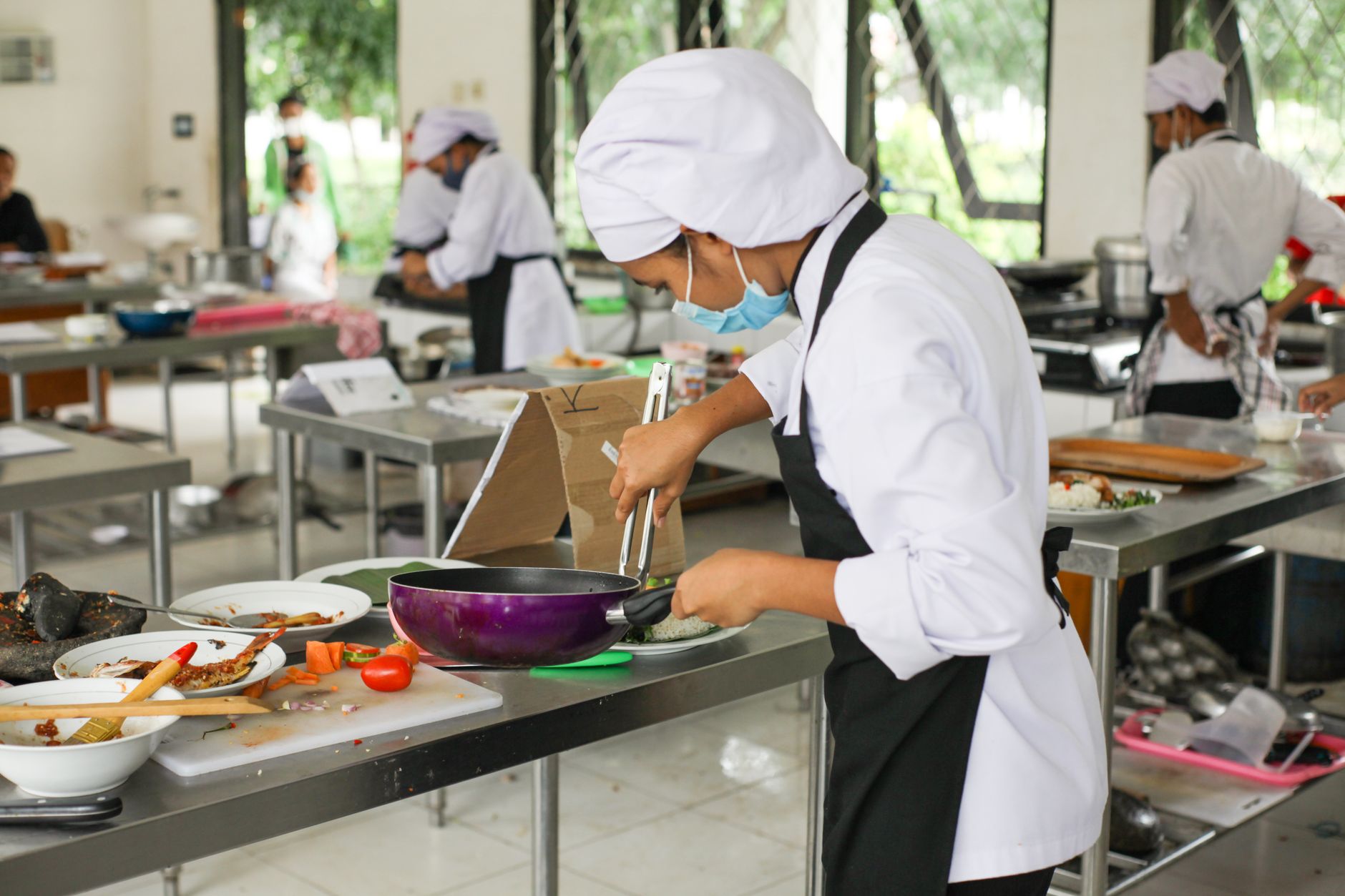
What a Culinary Arts Associate Degree Covers
A culinary arts associate degree is the standard first credential for a professional cook. It’s two years of kitchen labs, sanitation, baking, purchasing, cost control and nutrition, usually with general education courses and an internship or externship. It’s what most chefs mean when they say they went to culinary school.
The associate degree is also the most common culinary credential on this site after the certificate. There are 361 associate programs at 273 schools in 46 states and territories, and 317 of them are at public colleges. The median is 62 credits and 80 weeks, about two academic years full time.
Most associate degrees, 239 of them, are in culinary arts. Another 73 are baking and pastry degrees, 45 are culinary or food service management, and 4 are culinary science. The ranking above covers all four tracks, scored the same way.
The Top 10 Culinary Associate Degrees Compared
| School |
Degree |
Credits and length |
ACF status |
What the program states |
| St Philip’s College, TX |
Culinary Arts A.A.S. |
On campus |
Exemplary through June 30, 2029 |
Prepares ACF members for the CC or CPC; 183 awards in 2022-23 |
| Cincinnati State, OH |
Culinary Arts (CUL.AAB) |
61 credits, six semesters |
Exemplary |
Two 40-hour co-op electives |
| Grand Rapids CC, MI |
Culinary Arts A.A.A.S. |
2 years full time |
Exemplary |
Higher Learning Commission accredited college |
| Metropolitan CC, NE |
Sustainable Culinary Management A.A.S. |
On campus |
Exemplary |
44 awards in 2022-23 |
| Delgado CC, LA |
Culinary Arts A.A.S. |
About 2 years full time |
None stated |
13 of 13 employed in 2025-26; ACF certification rate 100% |
| Schenectady County CC, NY |
Culinary Arts A.O.S. |
On campus |
Exemplary since 2012 |
600-hour work experience |
| Helms College, GA |
A.A.S. Culinary Arts, Augusta |
On campus |
Accredited |
90% placement, 100% graduation, 12% ACF certifications (2024 YTD) |
| Henry Ford College, MI |
Culinary Arts A.A.S. |
71 credits |
Accredited |
Paid internship included |
| Sinclair CC, OH |
Hospitality Management and Tourism/Culinary Arts A.A.S. |
65 credits |
Accredited (ACFEF and ACPHA) |
122 awards in 2022-23 |
| UA-Pulaski Tech, AR |
Culinary Arts A.A.S. |
On campus |
Accredited |
Approximate $18,900 tuition and fees, plus $500 uniform and tools |
Seven of the ten are ACF accredited, and five hold exemplary status. Across all 361 associate programs, 72 state ACF accreditation and 12 are exemplary, so the top of this ranking is far more accredited than the field.
Degree Names: A.A.S., A.O.S., A.S. and More
Culinary associate degrees go by several names, and the name tells you less than the credit list does.
- A.A.S. (Associate of Applied Science) is the most common, used by Delgado, Henry Ford, Houston and most community colleges.
- A.O.S. (Associate in Occupational Studies) is used by the Culinary Institute of America, Schenectady and Erie Community College.
- A.S. (Associate of Science) appears at Johnson and Wales University in Providence, Hillsborough Community College and Gulf Coast State College.
- A.A.B. (Associate of Applied Business) is used by Cincinnati State and Zane State College.
- A.A. appears at Guam Community College and several California colleges.
Credit counts vary more than the names. Ferris State’s Restaurant and Food Industry Management associate degree lists 42 credits; Henry Ford lists 71; Southern Crescent Technical College’s A.A.S. lists 68. Quarter-credit schools look bigger on paper: Bellingham Technical College’s degree is 103 quarter credits over 7 quarters, and Escoffier Austin’s is 90 quarter credits.
What a Culinary Associate Degree Costs
Only 20 associate programs publish a whole-program total. The median is $11,392.
| Program |
Published total |
What it covers |
| Tarrant County College Culinary Arts AAS, TX |
$4,440 |
Tuition and fees, in-county, 2026-2027, excluding textbooks and materials |
| Wake Tech Baking and Pastry Arts AAS, NC |
$4,940 |
Estimated tuition and fees, in-state |
| Dallas College Culinary Arts A.A.S., TX |
$5,940 |
In-county, full-time estimate; tuition includes most required learning materials |
| Southeast Community College Culinary Arts A.A.S., NE |
$8,065 |
Estimated tuition, 63.5 credits |
| Atlanta Technical College Culinary Arts AAS, GA |
$10,100 |
Estimated program cost, 2026-27 catalog |
| McHenry County College Culinary Management AAS, IL |
$12,660 |
Total amount, in-district |
| Chippewa Valley Tech Culinary Management, WI |
$15,277 |
Four terms plus materials and books |
| Bellingham Technical College Culinary Arts AAS, WA |
$26,600 |
Tuition and fees over 7 quarters (estimated) |
| Columbia College, Vienna Culinary Arts A.A.S., VA |
$28,140 |
Based on course selections per session; 92 credits, hybrid |
| Escoffier, Austin Culinary Arts A.A.S., TX |
$40,535 |
Includes uniforms, toolkit and coursepacks, excludes books |
Many community colleges publish a rate instead. Finger Lakes Community College lists $5,616 a year in-state, or $234 per credit hour, for its 64-credit A.A.S. A rate isn’t a total: fees, knives and uniforms come on top. Tidewater Community College lists $195.25 per credit for 63 credits in its 2024 estimate, plus $1,377.45 in books and a $324.29 knife kit.
Internships, Co-Ops and Student-Run Restaurants
The degree’s biggest advantage over a short certificate is time in a working kitchen. Look at what each program requires:
- Schenectady County CC requires 600 hours of work experience, and Finger Lakes requires 600 or more hours of professional work experience.
- Johnson and Wales builds a 12-credit internship into its 61-credit Culinary Arts A.S.
- Henry Ford College includes a paid internship.
- Mitchell Technical College schedules a summer internship between the first and second year. See Mitchell Tech.
- Owens Community College runs a 320-hour co-op practicum at its student-run Terrace View Cafe. See Owens.
- Monroe University in the Bronx requires an internship at The Dining Lab, its student-run restaurant.
- College of DuPage says all its degree programs include internships.
25 associate programs run a student-run restaurant. Cooking for paying guests on a service night is the closest school gets to a real line.
Outcomes: Placement, Graduation and ACF Certification
24 associate programs publish a placement rate, with a median of 90%, and 19 publish a graduation or completion rate, with a median of 50%. In a typical program that publishes one, about half the students finish on the measured timeline, so the programs that publish strong completion deserve extra weight.
Tarrant County College reports graduation of 73%, 86% and 90% over 2020-21 to 2022-23, with placement at the same rates, program-wide. Mitchell Technical College reports 100% graduation for 2025 and 2024 and 100% placement for 2023 to 2025. South Plains College reports 82% graduation and 90% placement for 2023-2026, program-wide.
At the other end, Dallas College’s Culinary Arts A.A.S. reports 100% placement each year and a 3.5% completion rate by four years for its 2020 cohort, and Tidewater Community College reports a 6.4% three-year graduation rate.
ACF certification rates for degree graduates vary just as widely. Delgado and Houston Community College report 100%. Holyoke Community College reports 0% in 2023, 2024 and 2025. Bossier Parish reports 1% for 2024.
What the Degree Leads to
Most graduates start as line cooks or pastry cooks. The ACF’s ladder starts with the Certified Culinarian, an entry-level cook in a commercial kitchen, and runs to Certified Sous Chef, a chef who supervises a shift or station, and on to Certified Chef de Cuisine and Certified Executive Chef. Several degrees prepare you for the CC at graduation, including St Philip’s, Delgado, San Jacinto and Virginia Western.
The management courses in a degree are what move you toward sous chef and chef roles later. The median annual wage for chefs and head cooks was $62,470 in May 2025, with early mornings, late evenings, weekends and holidays part of the job.
If you want a bachelor’s, 16 programs on the site award one. The Culinary Institute of America’s 127-credit Culinary Science BPS includes a semester-long paid internship.
Where the Culinary Associate Degrees Are
New York has the most culinary associate degrees on this site, 29, from the CIA and Monroe University to SUNY Delhi, Erie, Schenectady and Monroe Community College. California and Texas have 28 each, North Carolina 20 and Georgia 17. Florida, Illinois, Michigan, New Jersey and Washington have 16 each.
In Florida, the associate degree is often an A.S. at a state college, and some connect to the technical college diplomas: Broward College awards 33 credits toward its 60-credit Culinary Arts Management A.S. for completing a Broward technical college’s culinary program. See culinary schools in New York and culinary schools in Florida.
How to Choose a Culinary Associate Degree
- Pick the track first. Culinary arts, baking and pastry or culinary management. The culinary arts vs baking and pastry guide explains the split.
- Check ACF status on the program page. 72 of 361 associate programs state it.
- Find the completion rate. Tarrant County’s 90% and Mitchell’s 100% are records worth having.
- Count work hours. 600 hours at Schenectady or Finger Lakes is a lot of real kitchen time.
- Price the whole degree. Tarrant County’s $4,440 excludes textbooks and materials; Escoffier’s $40,535 includes uniforms and toolkit.
If two years is too long, compare culinary certificate programs. If you already work in a kitchen, see culinary programs for working adults. The program comparer lines up any two degrees side by side.